
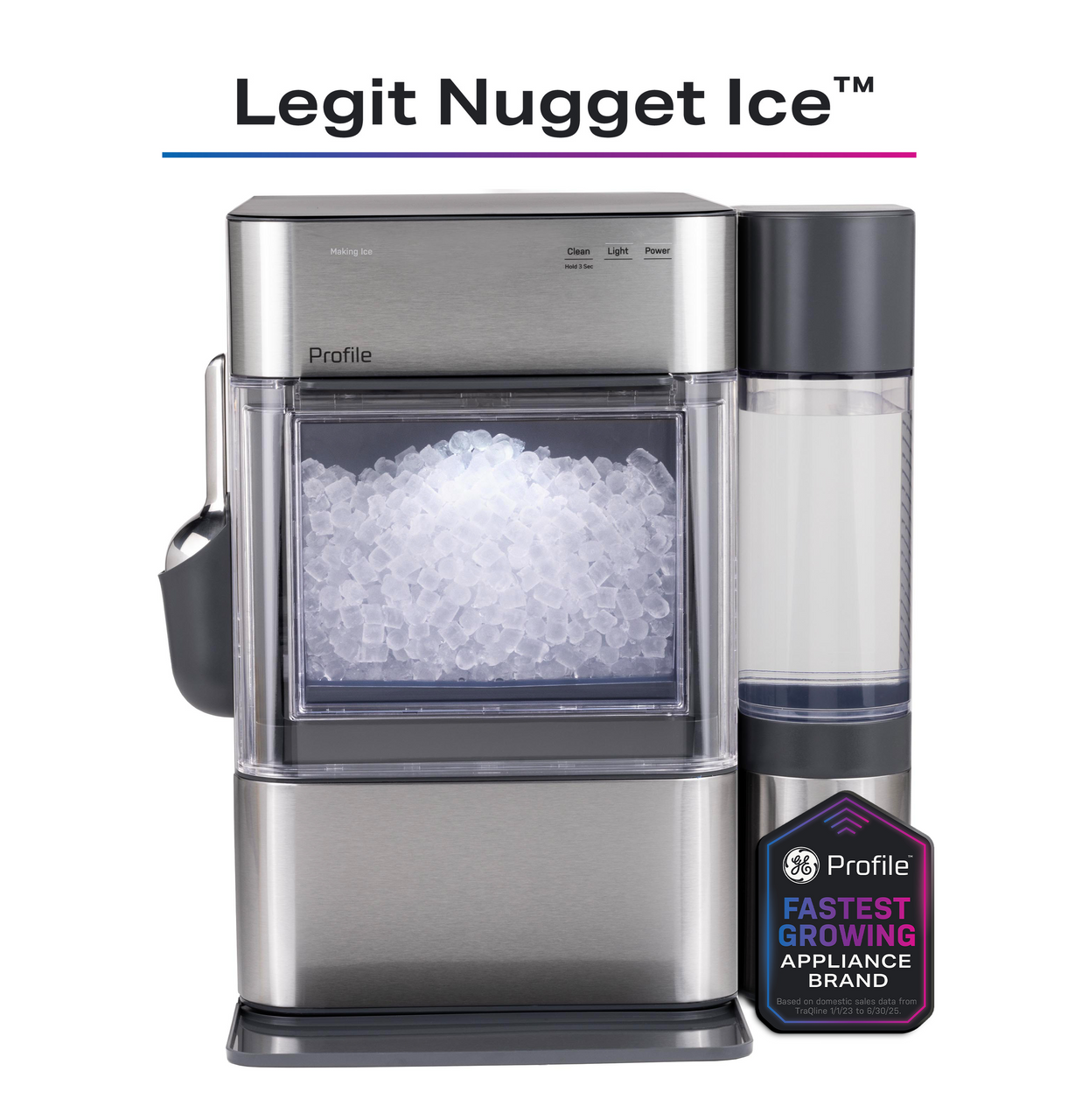
Your needs, this model
Does it fit your priorities?
Does this exact family combine nugget ice with an included one-gallon XL side tank?
Yes. The XPIOX3SZ models have nugget ice and the exact product pages specify a one-gallon XL side tank.
Explore this need in the finder →Can its warm-condition plan meet a 32-pound-per-day manufacturer claim?
Yes. GE separates 32 lb/day at 90°F room air / 70°F water from the higher 38 lb/day claim at 70°F / 60°F.
Explore this need in the finder →Is a three-pound collection-bin minimum documented?
Yes. GE lists a 3 lb bin; that is collection capacity, not daily output or frozen storage.
Explore this need in the finder →Does the XL-tank package fit a strict 13-inch maximum width?
No. GE lists 13.43 inches before the required four inches of side clearance.
Explore this need in the finder →Can an essential direct water-line connection be confirmed?
No direct water-line connection is documented in the exact package page or linked manual; the unit is filled manually and the side tank feeds its reservoir.
Explore this need in the finder →Can the three-pound bin keep a stored batch frozen for later?
No powered frozen-holding mode is documented. The manual describes recirculating melt-water, so longer storage needs separate freezer space.
Explore this need in the finder →Start with the package, not just the Opal name
The GE Profile Opal 2.0 Ultra XPIOX3SZSS is the stainless-steel version of GE's one-gallon XL side-tank package. GE also lists the same XPIOX3SZ configuration in Moonstone Blue (XPIOX3SZMO), Chocolate Quartz (XPIOX3SZEB) and Black (XPIOX3SZBT). Their exact product pages show the same nugget format, three-pound bin and 13.43-by-17.5-by-16.5-inch listed body. The supplied-tank arrangement, not the finish, is the functional reason to consider this group.
That makes it worth separating from the other Opal Ultra packages. XPIO13SWSS has a standard 0.75-gallon side tank; XPIO23SWSS has no side tank supplied and is listed at a narrower 10.5-inch width. XPIOX3SZSS's one-gallon tank is a larger water buffer, not an extra ice bin. It reduces how often you have to refill, but still leaves you handling and cleaning a separate water container.
Its production claim depends on room and water temperature
GE lists up to 38 pounds a day at 70°F ambient air with 60°F water, then gives 32 pounds a day at 90°F air and 70°F water under its DOE condition. These are manufacturer claims, not measured output from our kitchen. If your room and incoming water are closer to the warmer pair, use the 32-pound figure rather than planning around 38. The XL tank is not a promise of faster output; it simply provides more water between refills.
The pull-out bin is listed for three pounds. That number describes what it collects at once, not a day's production. Once the bin fills, empty it to make room for more ice. GE's manual describes the water moving through a circulating system, and the bin is not a powered freezer. For a later serving, move collected ice to a separate freezer rather than treating the drawer as frozen storage.
Measure the working station as well as the body
The listed width is 13.43 inches and depth is 17.5 inches, but the manual asks for four inches of air clearance at both sides and behind the machine. That makes a narrow gap between cabinets a poor fit even if the closed body can be pushed into it. Keep the top accessible for loading the side tank and opening the ice bin; overhead cabinetry, nearby heat and direct sun also affect the setup. GE describes indoor household use on a flat, level surface, with an operating environment of 55°F to 90°F.
The manual permits the side tank on either the left or right. It also says to keep the tank base on the same level surface as the Opal, align the connecting tube, and not elevate the tank. The filled tank can be heavy. Allow space to lift it out, fill it at the sink and return it without pulling the machine across the counter. This is useful for a busy drinks station where frequent manual refills are an annoyance, but not for someone who wants a plumbed appliance: the exact page and linked manual do not document a water-line connection.
Care is more than a button
The Ultra control panel has a Clean button: a tap starts a sanitizing or rinse cycle and a hold starts descaling. The manual still calls for hands-on care. It separates descaling for mineral deposits from sanitizing, recommends more frequent descaling with hard water, and describes removing the bin and drip tray for cleaning. The side tank is hand-wash only, including its cap, valve and base well; it is not a dishwasher part. There are multiple drain tubes at the back, so follow the linked manual's diagram before disconnecting anything, and drain the unit before moving it or leaving it unused for several days.
The exact product page says the Opal is compatible with GE's taste-and-odor and scale-inhibiting filters. It does not establish that every filter is included with every retail listing. Confirm the box contents and filter option against the exact seller's package. The 2.0 Ultra manual also says to check and clean the rear air filter regularly. App connectivity can schedule production and send maintenance alerts, but it cannot add water, empty a full bin or replace cleaning.
Choosing the exact finish—and checking the model's status
For the XPIOX3SZ group, Stainless Steel, Moonstone Blue, Chocolate Quartz and Black are finish choices with separate model numbers and product pages. The four source-page images show the same body-and-tank layout in those finishes; GE does not say whether the marketing images are photographs, renders or composites. No performance difference by finish is documented, so buy or compare by the full suffix rather than a retailer's shortened “Opal Ultra” title.
There is a lifecycle conflict worth keeping visible. The GE sales pages currently say these exact models are out of stock and no longer being manufactured, while their Owner Center pages show a May 2026-to-present manufacturing range. I treat the family as an earlier-model comparison and keep it out of ordinary current recommendations until GE resolves that conflict. Confirm the actual label, tank, filter and seller package before considering remaining or used stock; no price or availability is assumed here.
Choose this configuration when nugget ice and fewer water refills justify the extra tank footprint and care. Choose XPIO13 when a smaller standard side tank is enough, or XPIO23 when counter width matters more than a supplied tank. If a true water-line connection, a narrow 13-inch opening or a frozen stockpile is essential, the XPIOX3SZ package does not meet that need.
Sources: GE's exact XPIOX3SZSS page, XPIOX3SZMO, XPIOX3SZEB and XPIOX3SZBT pages, the linked XPIOX3-series manual, and the GE XPIOX3SZSS Owner Center.
Key details at a glance
| Ice shape | nugget |
|---|---|
| Manufacturer daily output claim | GE states up to 38 lb/day at 70°F ambient air / 60°F water and 32 lb/day at 90°F ambient air / 70°F water per DOE. |
| Documented collection basket | 3 lb |
| Dedicated cleaning cycle confirmed | Yes |
| Side tank included | Yes |
| Listed closed width | 13.43 in |
| Listed closed depth | 17.5 in |
| Listed closed height | 16.5 in |
| Dedicated powered frozen-retention feature | No |
| Cleaning/rinse operation | Manual-guided sanitize/rinse by tap; hold Clean to descale |
| App ice-production control confirmed | Yes |
| Frozen-holding limits | The three-pound bin collects nugget ice; GE's manual describes melt-water recirculation and does not document powered frozen holding. |
| Side-tank water capacity | 1 gal |
Use the exact model’s instructions for operating limits, supplied equipment and version differences.
Sources for this assessment
Find an ice maker for your serving routine.
Compare ice shape, collection capacity and useful care features.